On the Cost of Making a Difference
By Mr. Gift Edegware · July 1, 2026 · 6 min read
Every person who wants to make a difference at some point has to decide whether they care more about the people's lives they're changing or the people's opinions they're offending. A reflection from eight years of building software companies in Lagos.
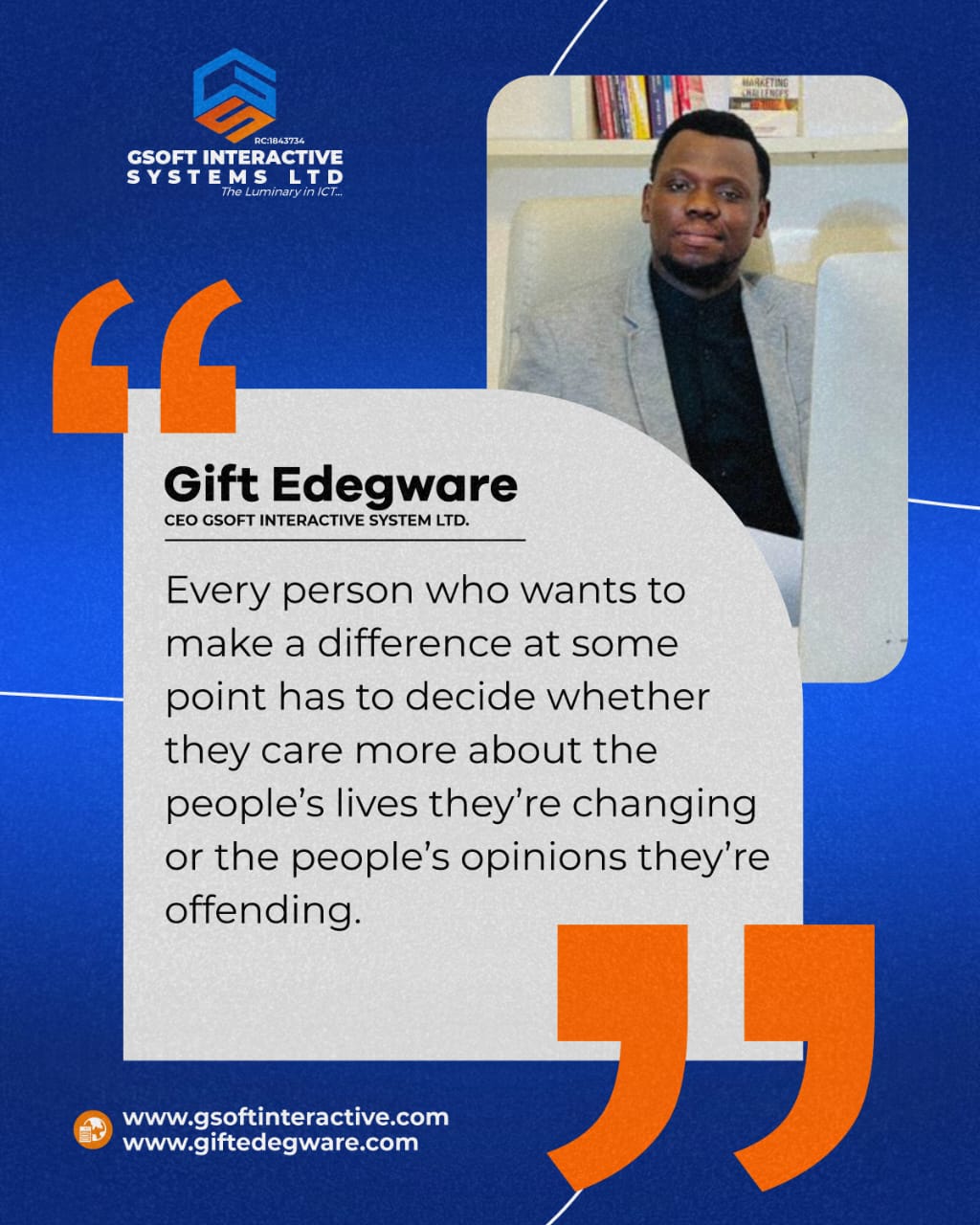
Some years into running Gsoft, I wrote something down that I keep returning to:
Every person who wants to make a difference at some point has to decide whether they care more about the people’s lives they’re changing or the people’s opinions they’re offending.
I didn’t understand what it meant when I first thought it. I’ve been learning what it means ever since.
The fork
The fork is real, and it’s more common than people admit.
You build something. You care about the people it’s for. And at some point you realise the shape of the thing you have to build — the version that actually works, that actually helps, that actually moves the number — is a shape that will inconvenience, disappoint, or actively upset someone.
Sometimes that someone is a client who wants a different product than the one that would serve them. Sometimes it’s a senior figure whose opinion you’d rather protect. Sometimes it’s a partner who quietly wanted a different priority. Sometimes — most uncomfortably — it’s yourself, and the version of your reputation you’d like to preserve.
At the fork, you don’t get to have both. You have to choose.
Two examples I’ve watched
I’ve watched a Nigerian founder scale a fintech to a size that mattered — but only after they decided, publicly and permanently, to stop taking meetings with a particular class of investor who had been advising them to stay small. The advice was gentle. The advice was also wrong. Turning it down cost them relationships they respected. It also let them serve hundreds of thousands of users who wouldn’t have been reached otherwise.
I’ve watched a government agency approve a digital platform that made previously buried information radically visible — knowing that some officials would prefer the burial. The people who benefited were the citizens. The people offended were smaller in number but louder in the room. The agency chose the citizens. The offended voices did what offended voices do. The platform is still up. The critics have moved on to the next thing.
Neither of those choices was easy. Both were correct.
What “offending” actually means at the fork
At the fork, “offending” almost never means causing genuine harm. It means:
- Deciding what your product is for, and therefore what it isn’t.
- Saying no to work you could have taken.
- Publishing an opinion someone will disagree with.
- Choosing a technology, a partner, or a hire that a respected voice would have picked differently.
- Refusing a shortcut that would have made someone happy.
These are the small offences. They aren’t cruelties. They’re the ordinary friction of doing anything real. But they add up, and in aggregate they mean that some people will hold an opinion of you that you’d rather they didn’t.
You cannot make a difference without accumulating that friction. There is no version of substantial work that leaves everyone satisfied.
The trap
The trap is not to refuse the offended opinion when it arrives. That’s easy, and most founders eventually learn to do it. The trap is to let the anticipated offence decide the work in advance.
You build a lesser product because a harsher version might upset an investor. You take on a client you shouldn’t, because turning them down would create a story. You hold back a piece of writing because a friend might read it and wince. You skip the hard conversation with the senior engineer because you don’t want to be the founder who has that conversation.
The offence hasn’t happened. The lives aren’t being changed either. You’ve optimised for a situation that only exists inside your head.
What I’ve come to believe
I’ve come to believe two things about the fork.
The first is that the offence is smaller than you predict. You imagine a wave of criticism. You get, at most, a raised eyebrow, a silence, a message from someone you’d forgotten. Then people move on. The world is not paying nearly as much attention to your decisions as your fear implies.
The second is that the lives you change do not usually thank you. They don’t know the alternative version of the product you didn’t build, the client you didn’t take, the compromise you didn’t make. They benefit quietly. The person who was going to be offended, meanwhile, will be very audible.
Making a difference means accepting an asymmetric signal. The offended will speak. The helped will remain silent. If you weight the signals by volume, you will always drift back toward the version of the work that offends no one and helps no one either.
The only way through the fork is to weight the signals by their reality, not by their volume.
The daily version
Most days the fork isn’t dramatic. It’s a small email you’re avoiding sending. A feature you’re softening because someone in a meeting frowned. A price you’re not charging what you think the work is worth. A hire you’re not making because you don’t want the departure of the person who’d need to leave.
The daily version of the fork is where the character of the work gets set. Not in the dramatic moments — in the quiet email you send or don’t send today.
A closing word
If you’re reading this and there’s a version of the fork on your desk right now — a decision you’re softening because you’d rather not offend someone who would prefer the softer version — let this piece be the small nudge.
Send the email. Ship the version. Take the position. Refuse the shortcut.
The people whose lives you’re trying to change will thank you eventually. The people offended will move on. And the work — the real, actual work you set out to do — will finally start moving.
If you’re leading a business or a team through a decision like this and could use a second set of eyes, I take a small number of advisory engagements each year. Book a 30-minute call.